If you’re searching for in-home care for an aging parent, a spouse recovering from surgery, or a loved one with a disability, you’ve probably already discovered that there are many agencies operating in the Las Vegas area — and that they are not all equal. Licensing requirements, caregiver screening practices, backup coverage protocols, and pricing transparency vary significantly from one agency to the next.
The answer is to ask the right questions directly — before you sign any agreement, before a caregiver ever sets foot in your home. A reputable agency will answer these questions clearly, confidently, and in writing. Here are eight essential questions to ask any home care agency in Las Vegas, along with the answers you should be looking for and the red flags that warrant concern.
Question 1: Are You Licensed as a Non-Medical Home Care Agency in Nevada?
Nevada requires non-medical home care agencies to be licensed by the Nevada Division of Public and Behavioral Health (DPBH). A valid state license means the agency has met minimum operational, training, and safety standards required by law. Ask to see the license number and verify it independently if you have any doubt. Family Personal Care is a licensed and insured non-medical personal care agency based in North Las Vegas, Nevada.
Question 2: Are Your Caregivers Insured?
Insurance protects your family if a caregiver causes accidental damage to property or is injured on the job. General liability insurance covers property damage or injury claims. Workers’ compensation insurance ensures that if a caregiver is injured in your home, their medical care and lost wages are handled through the agency — not through a claim against your homeowner’s insurance. Any reputable agency carries both.
Question 3: What Background Checks Do You Run on Caregivers?
Background screening is one of the most critical safeguards in home care. Ask specifically: does the agency run a criminal background check on every caregiver before hiring? Does that check include national and state databases? A thorough answer should make clear that the agency screens every caregiver — not just most — and that the screening goes beyond a basic name search. This is non-negotiable when the care recipient is a vulnerable adult.
Question 4: What Training Do Your Caregivers Receive?
Ask whether the agency provides any training to caregivers beyond the state minimum. Strong agencies train caregivers on dementia care, fall prevention, emergency response protocols, infection control, and other topics relevant to serving seniors and adults with disabilities. The answer you’re looking for includes specific training topics and ongoing education requirements — not just a vague “our caregivers are highly trained” assurance.
Question 5: How Do You Match Caregivers to Clients?
A good match between caregiver and client is one of the most important factors in the quality and consistency of home care. Ask how the agency makes match decisions: do they consider personality, communication style, shared interests, and the specific care needs of your loved one? Agencies that take matching seriously will describe a real process. Agencies that don’t will give you a generic answer about all caregivers being equally qualified.
Question 6: What Happens If a Caregiver Calls In Sick?
Reliability is everything in home care. A single missed visit can mean a senior going without meals, personal care, or medication reminders for an entire day. Ask explicitly: does the agency maintain a roster of backup caregivers? Is there a guaranteed coverage protocol when a scheduled caregiver is unavailable? This is an area where agency-based care has a fundamental advantage over private hire — a legitimate agency should have a clear backup plan, not just a best-effort promise.
Question 7: Is Your Pricing Transparent, and Are There Any Hidden Fees?
Home care pricing should be straightforward. Ask for the hourly rate for the type of care you need, and ask specifically whether there are any fees on top of that: minimum hour requirements per visit, weekend or holiday rate premiums, enrollment or start-up fees, or cancellation penalties. Transparency is a signal of a trustworthy agency. Reluctance to provide written pricing is a warning sign that the actual costs may be higher than initially presented.
Question 8: Do You Work with ADSD or Accept Insurance?
For families seeking to offset the cost of home care through Nevada state programs or insurance, this question is essential. Ask whether the agency is an approved provider under Nevada ADSD Medicaid Waiver programs. Ask whether they have experience working with long-term care insurance policies and can assist with billing. An agency with this experience will be a much smoother partner for families navigating these funding sources.
Red Flags to Watch For When Evaluating a Home Care Agency
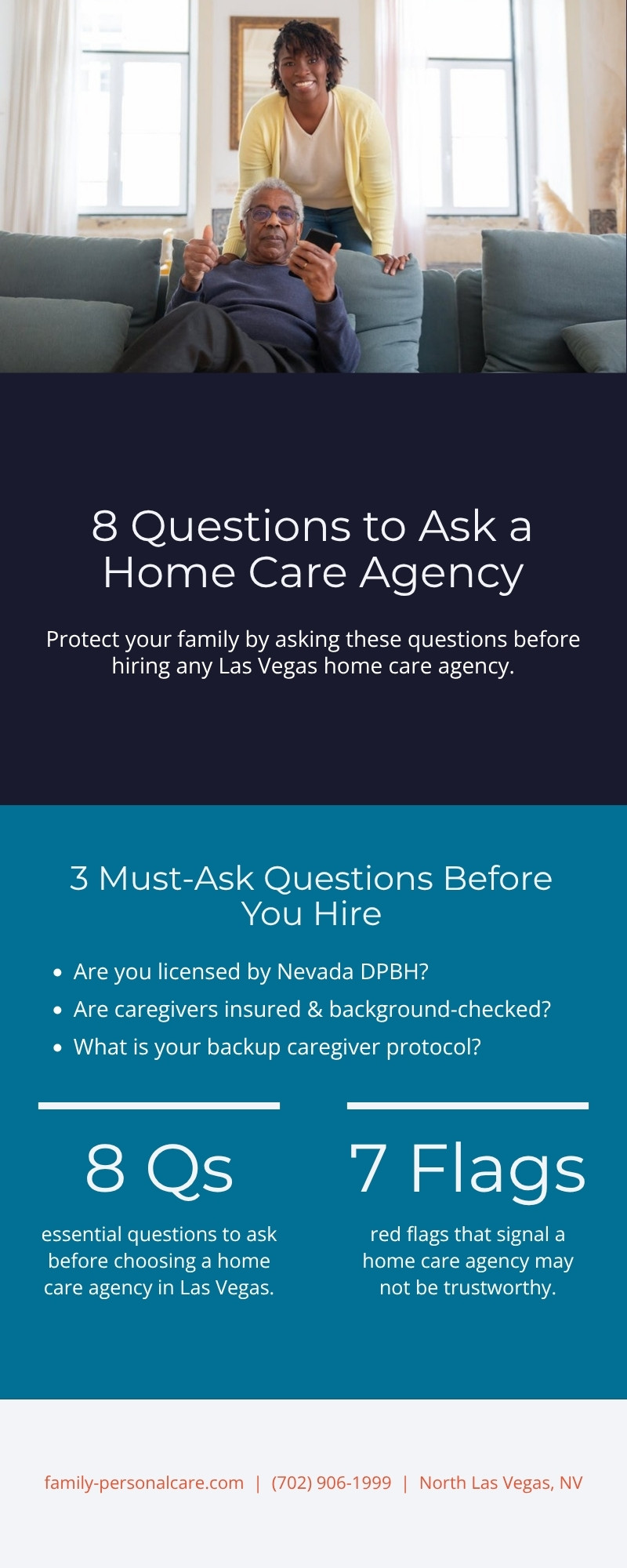
- Inability to answer basic questions about licensing, insurance, or background checks
- No written service agreement — all care arrangements should be documented in a signed contract
- Pressure to decide quickly or sign before you’re ready
- Vague descriptions of caregiver training with no specifics
- No backup caregiver protocol — “call-outs happen but we do our best” is not a plan
- Rates that seem unusually low — significantly below-market pricing often reflects corner-cutting on screening, training, or insurance
- Suggestions that you pay the caregiver directly rather than through the agency — this eliminates your legal protections
How Family Personal Care Answers These Questions
At Family Personal Care, we welcome every question on this list — and we answer them all directly, in writing, before you make any commitment. We are a licensed non-medical personal care agency based in North Las Vegas. Our caregivers are insured, background-checked, and trained on dementia care, fall prevention, and emergency protocols.
Our pricing is transparent: we provide written rate information upfront with no hidden fees, no startup costs, and clear documentation of everything included in each level of service. We work with ADSD Medicaid Waiver clients and have experience assisting families with long-term care insurance billing. We maintain backup caregiver coverage so that a scheduled visit is never simply cancelled without a replacement.
Frequently Asked Questions About Choosing Home Care in Las Vegas
What is the difference between a home care agency and a private caregiver?
A home care agency employs caregivers directly, handles all payroll taxes, provides workers’ compensation and liability insurance, conducts background checks, and can provide backup coverage when a scheduled caregiver is unavailable. A private caregiver is hired directly by the family, which means the family takes on employer responsibilities — including taxes, insurance, and finding replacement coverage.
Is it cheaper to hire a private caregiver instead of going through a Las Vegas agency?
The hourly rate quoted by a private caregiver is often lower than an agency rate — but the total cost when you account for employer-side payroll taxes, workers’ compensation insurance, and the financial and logistical burden of managing a replacement when the caregiver is unavailable often makes private hire more costly and more stressful than it initially appears.
Does Family Personal Care offer a free consultation before signing?
Yes. Family Personal Care offers a complimentary in-home care consultation at no obligation. A care coordinator will visit the home, assess your loved one’s needs, explain all available service options and pricing, and answer any questions — including every question on this list.
Ready to Ask These Questions to Family Personal Care?
We encourage every family to take their time, ask hard questions, and choose the home care agency they trust most. At Family Personal Care, we are proud to answer every question on this list directly and in writing. Contact us today to schedule your complimentary consultation — no pressure, no commitment, just answers.