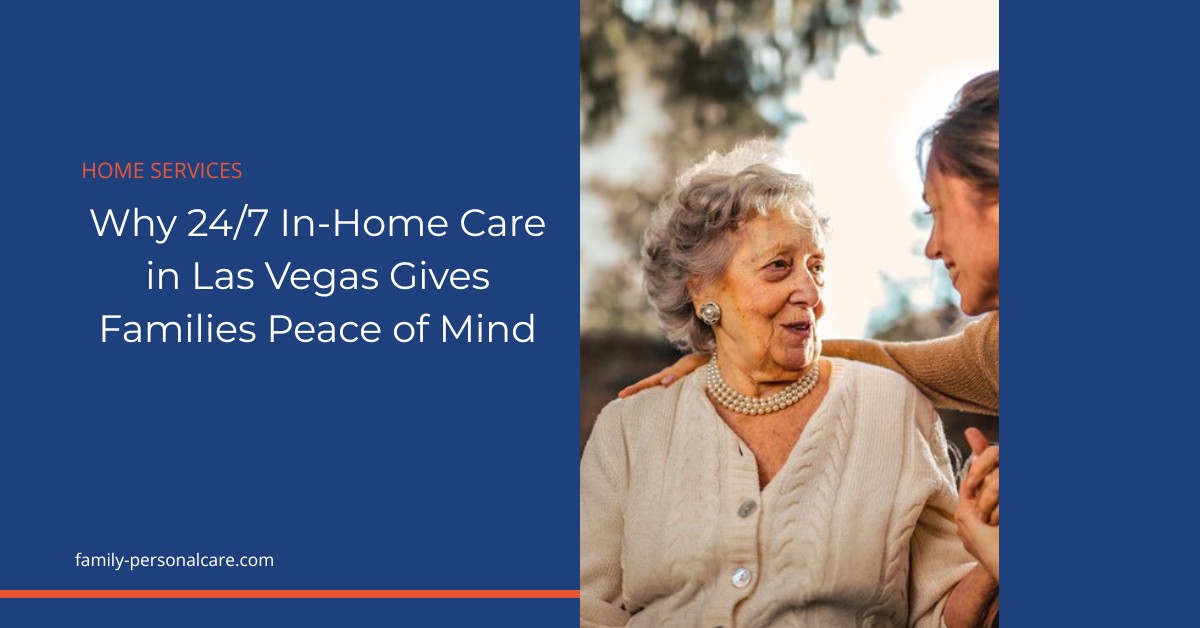
There comes a point in many families’ lives when checking on an aging parent once or twice a day is no longer enough. A chronic illness, a recent fall, the early stages of dementia, or simply the reality of advancing age can make continuous in-home care not just helpful — but essential. For Las Vegas families, 24/7 in-home care means your loved one is never alone during a medical moment, a difficult night, or an unexpected emergency.
Unlike a nursing facility or assisted living community, 24/7 home care allows your loved one to remain in the comfort and familiarity of their own home — in the neighborhood they know, surrounded by their own belongings — while receiving the level of attention their condition requires. It offers something no facility truly can: the reassurance that someone who knows your loved one personally is present at all times.
This guide explains what 24/7 in-home care looks like in practice, the warning signs that indicate a senior may need around-the-clock support, and how Las Vegas families can access this level of care through Family Personal Care.
What Does 24/7 In-Home Care Actually Include?
24/7 in-home care means a trained non-medical caregiver is present in the home continuously — day and night, seven days a week. This is distinct from periodic home visits, where a caregiver comes for a scheduled block of hours and then leaves. With continuous care, there is always someone present to help with personal care, monitor safety, provide companionship, respond to urgent situations, and ensure that medications are taken on schedule.
Non-medical 24/7 in-home care services typically include:
- Personal hygiene assistance (bathing, grooming, dressing)
- Meal preparation and feeding assistance
- Medication reminders and management support
- Mobility assistance and fall prevention
- Companionship and cognitive engagement
- Overnight monitoring and nighttime support
- Light housekeeping and laundry
It is important to note that non-medical in-home care does not include clinical services such as wound care, IV therapy, or medication administration by injection. For seniors who need clinical support alongside personal care, the two types of care can be coordinated through separate providers.
24-Hour Care vs. Live-In Care: What’s the Difference?
These two terms sound similar but represent meaningfully different arrangements. With 24-hour care, caregivers work in rotating shifts — typically 8- or 12-hour shifts — so there is always a fully alert, awake caregiver present. With live-in care, a single caregiver resides in the home and is available during the day but is entitled to a designated sleep period overnight (typically eight hours). If the senior requires nighttime assistance, a live-in arrangement may not meet that need consistently.
For seniors with dementia who wander at night, those recovering from surgery or illness, or those with a high fall risk after dark, true 24-hour care with shift rotations is the more appropriate and safer option. Family Personal Care can help assess which model is right for your loved one’s specific situation.
7 Warning Signs Your Loved One May Need 24/7 In-Home Care
If you are unsure whether your family member has crossed the threshold from part-time support to full-time care, these warning signs are a reliable guide. Even one or two of these indicators warrant a serious conversation with their physician and a care coordinator.
1. Frequent falls — especially at night
Falls are the leading cause of serious injury in adults over 65. If a senior has fallen more than once in the past six months, or has had a near-miss that went unreported, continuous overnight monitoring can be lifesaving.
2. Wandering or disorientation
Seniors with dementia or Alzheimer’s disease often wander during nighttime hours, a dangerous behavior that escalates rapidly without supervision. 24/7 care is strongly recommended for any senior with a documented history of nighttime wandering.
3. Inability to be left alone safely during any part of the day
If a family member or physician has expressed concern about leaving the senior unattended — even briefly — this is a direct signal that the current level of care is insufficient. Continuous care eliminates those gaps entirely.
4. Recent hospitalization or surgery
The post-discharge period is when seniors are most vulnerable. Medication errors, dehydration, falls, and infection are all more likely during recovery. Around-the-clock support during the first few weeks following a hospital stay can prevent a costly readmission.
5. Significant cognitive decline affecting safety judgment
A senior who can no longer reliably assess whether the stove is off, whether they have taken their medications, or whether they are safe to walk unassisted needs someone present to catch those lapses before they become emergencies.
6. Family caregiver exhaustion or crisis
When the primary family caregiver reaches a physical or emotional breaking point, the quality of care declines rapidly — and the risk to the senior increases. Transitioning to professional 24/7 care is not an admission of failure; it is a responsible decision that protects both the senior and the family. Respite care can also help prevent burnout before it reaches a crisis point.
7. Documented physician recommendation
If the senior’s primary care physician or specialist has recommended increased supervision or around-the-clock monitoring, that recommendation should be treated as medical advice. A care assessment can then determine whether in-home 24/7 care, assisted living, or another setting best meets those requirements.
Why Las Vegas Families Choose 24/7 In-Home Care Over a Nursing Facility
When a senior reaches the point of needing continuous care, many families automatically assume that means a transition to a nursing home or memory care facility. But 24/7 in-home care is a genuine alternative that preserves quality of life in ways facilities cannot replicate. Explore our full range of services to understand what’s available.
- Familiarity: Seniors with dementia in particular experience significantly less anxiety and behavioral disruption when they remain in a familiar home environment.
- Personalized attention: A dedicated caregiver provides one-on-one attention rather than a staff-to-resident ratio spread across an entire unit.
- Family involvement: Family members can visit at any time, help with care, and remain closely involved in daily decisions — something that is far more restricted in a facility setting.
- Dignity and independence: Remaining at home allows seniors to maintain their routines, their possessions, and a sense of personal agency that institutional settings cannot fully replicate.
For many Las Vegas families serving North Las Vegas, Henderson, Summerlin, and the broader valley, 24/7 in-home care delivers comparable safety to a care facility while meaningfully improving quality of life.
Frequently Asked Questions About 24/7 Home Care in Las Vegas
What is the difference between 24-hour care and live-in care?
24-hour care uses rotating shifts of caregivers to ensure a fully alert, awake caregiver is always present — including overnight. Live-in care involves a single caregiver who resides in the home and is entitled to a sleep period each night. For seniors who need active nighttime monitoring, 24-hour shift-based care is typically the appropriate choice.
Is 24/7 in-home care in Las Vegas covered by Medicare or insurance?
Medicare does not cover non-medical 24/7 in-home care. Some long-term care insurance policies do cover around-the-clock home care — check your policy’s daily benefit limit and elimination period. Nevada Medicaid Waiver programs may cover personal care hours for qualifying seniors, though the total authorized hours vary by individual assessment. Family Personal Care can help families explore available funding sources including Nevada ADSD programs and long-term care insurance coordination.
How do I get started with 24/7 home care in Las Vegas through Family Personal Care?
Contact Family Personal Care at (702) 906-1999 to schedule a no-obligation in-home assessment. A care coordinator will evaluate your loved one’s current needs, discuss scheduling options, and explain exactly what continuous care includes and costs. We serve North Las Vegas, Las Vegas, Henderson, Summerlin, and surrounding communities.
Can 24/7 care be provided by multiple caregivers, or does it need to be the same person every day?
For true 24/7 care, multiple caregivers work in rotation — typically in 8- or 12-hour shifts. While consistency is important, a good agency will introduce all caregivers to the client before the schedule begins and will work to assign the same caregivers consistently so that your loved one develops familiarity and comfort with the team.
Talk to Family Personal Care About 24/7 Home Care in Las Vegas
If a loved one is showing signs that they need more support than hourly visits can provide, don’t wait for a crisis to force the decision. Family Personal Care provides compassionate, professional 24/7 non-medical home care across North Las Vegas, Las Vegas, Henderson, and Summerlin. Our care coordinators will help you understand your options, assess your loved one’s needs, and build a continuous care plan that works for your family.
Family Personal Care LLC | North Las Vegas, NV | (702) 906-1999 | family-personalcare.com